Navigation
Passage planning and weather windows
Almost every serious problem on a passage traces back to a decision made ashore: leaving when you should not have. Planning is not paperwork — it is the part of the job where safety is actually earned.
Published on
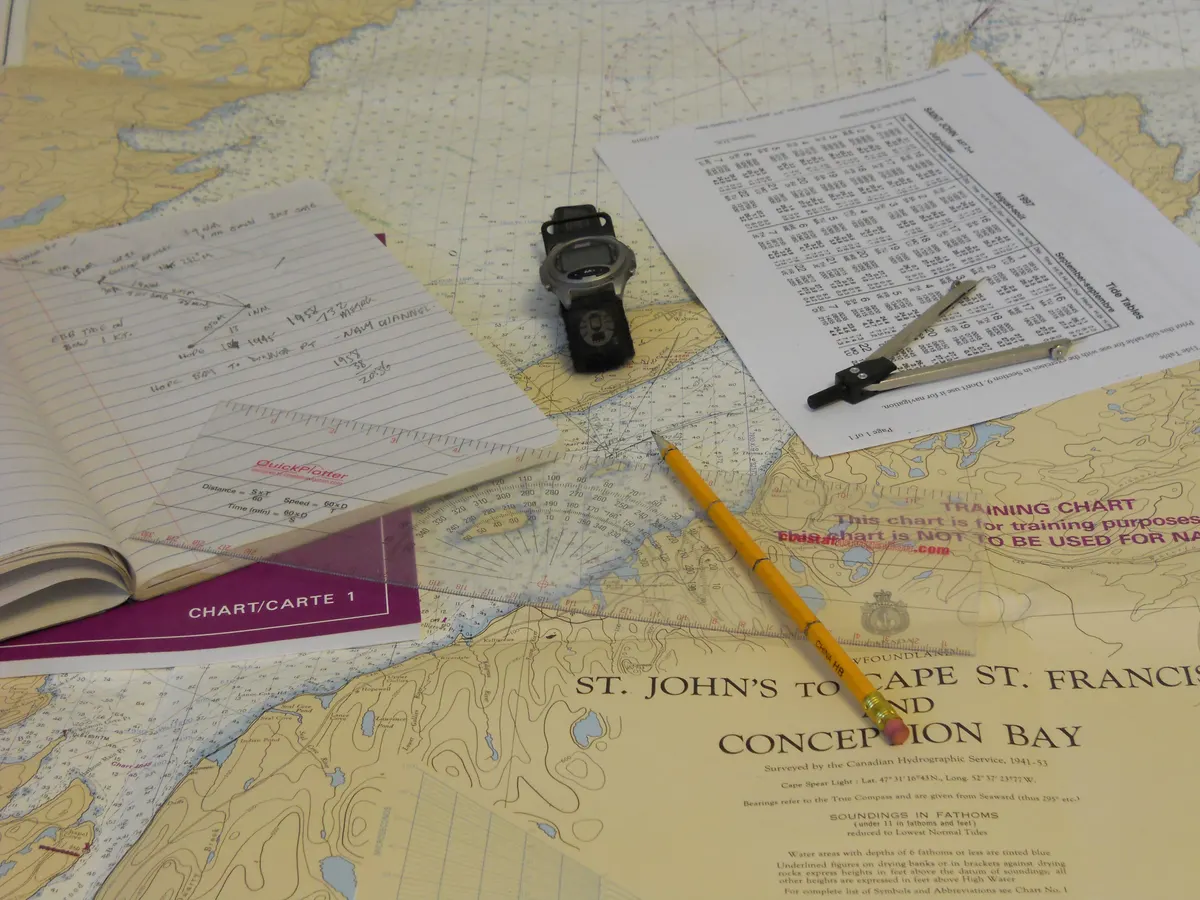
Photo by J. S. Bond · CC BY-SA 3.0
Drawing the route
We calculate the track, total miles and estimated time using a conservative average speed, not the brochure figure. From there we mark ports of refuge along the route, with their hours, entrance depths and night accessibility.
We also review the awkward areas: traffic separation schemes, fishing grounds, headlands with known acceleration and restricted or protected zones. All of that goes into the plan before departure.
The window
A weather window is a stretch of time in which forecast conditions sit inside the limits we have set for that boat and that crew. Those limits are defined beforehand, calmly: maximum wind, maximum sea, acceptable direction.
We consult several models, not one. When they agree, confidence is high; when they diverge, the window is treated as doubtful and we wait. And we look again right before casting off, because a twelve-hour-old forecast is already old.
Plan B
No passage is planned on a single scenario. For each leg there is an alternative: if the wind veers and builds past a certain point, where do we duck in; if the engine plays up, which port is to leeward; if the crew is spent, where do we stop and rest.
Deciding that in advance avoids improvising while tired and in the dark, which is when mistakes get made.
Saying no
Sometimes the professional answer is that we are not going. It is hard to explain when there is a committed date, but a boat arriving three days late is a scheduling problem and a boat arriving damaged is a real one.
That is why our quotes always talk about a window of dates rather than an exact day: the weather decides, and it is better written down from the start.
Frequently asked questions
What if bad weather delays the delivery?
The owner is informed and we wait for the next window. That is why we work with a range of dates rather than a fixed day.
Do you sail at night on a delivery?
Yes, routinely. On longer passages it is unavoidable, and it is organised with a watch system that guarantees real rest for the whole crew.
Which weather models do you use?
We compare several rather than trusting one. If they agree the window is reliable; if they disagree, we wait.